 Login
Login

When people search for the best kratom, they may be looking for very different things.
Some may mean the product with the strongest reputation. Others may mean a particular color, format, alkaloid profile, or price point. Some may simply want to know which kratom products provide enough information for them to make a more informed purchasing decision.
That last question is where a useful quality checklist begins.
There is no universal scientific ranking that establishes one kratom product as the “best.” Product composition can vary, commercial labels can mean different things, and laboratory testing only tells you about the sample that was actually analyzed.
So instead of asking, “Which kratom is the best?”, a more useful question is:
“What evidence and product information should I look for when evaluating kratom?”
This guide answers that question for adults 21 and older.
It focuses on practical quality indicators such as product identity, ingredient information, labeling, laboratory documentation, Certificates of Analysis, contaminant testing, alkaloid information, transparency, and regulatory awareness.
It also explains what these indicators cannot prove.
The best kratom for a responsible buyer is not necessarily the strongest, most expensive, or most heavily marketed product. A better evaluation starts with transparent product information, clear labeling, relevant laboratory documentation, identifiable batch or lot information, and a company willing to make its quality information accessible.
Why “Best Kratom” Is a Difficult Question
The word “best” sounds objective, but it usually hides several different criteria.
For example, one buyer may prioritize:
- Product format
- Label clarity
- Laboratory documentation
- Alkaloid information
- Ingredient transparency
- Company information
- Price
- Packaging
- Product variety
Another buyer may care about completely different characteristics.
That means a responsible buyer’s guide should not simply publish a list of products and call one of them “best.”
Instead, it should explain how to evaluate the information behind the product.
“Best” does not mean “strongest”
One of the most important distinctions is between quality and concentration.
A product containing a higher measured amount of an alkaloid is not automatically a higher-quality product.
Quality evaluation involves multiple dimensions:
| Quality question | Why it matters |
|---|---|
| What exactly is the product? | Establishes product identity |
| What ingredients are listed? | Helps clarify composition |
| Is testing available? | Provides independent analytical information |
| What sample was tested? | Helps determine whether results are relevant |
| Are results tied to a batch or lot? | Improves traceability |
| What was tested? | Shows the scope of the laboratory analysis |
| Is labeling clear? | Helps consumers understand the product |
| Are claims supported? | Separates information from marketing |
| Is current regulatory information available? | Laws and requirements can change |
The goal is not to find the product with the biggest number. It is to find enough reliable information to make an informed decision.
1. Start With Product Identity
Before thinking about color, strain names, concentration, or price, determine what you are actually buying.
Kratom comes from the botanical species Mitragyna speciosa. Commercial products can be presented in multiple formats, including powders, capsules, extracts, gummies, and shots.
The format alone does not tell you the complete composition.
For example:
- A capsule may contain powdered plant material.
- A capsule may contain an extract.
- An extract may have a different chemical profile from ordinary powdered leaf.
- A liquid product may contain additional ingredients.
- A product marketed around a particular alkaloid may be substantially different from ordinary botanical kratom.
This is why the product description and ingredient information matter more than the product name alone.
A useful first question
“What exactly is in this product?”
If the answer is difficult to determine from the label or product documentation, you have less information with which to evaluate it.
PurKratom's educational material on what kratom is and how Mitragyna speciosa products differ can provide additional background for readers who want to understand the botanical before comparing products.
2. Read the Ingredient and Product Label
A quality checklist should always include the label.
Look for information that allows you to identify:
- The product name
- The product format
- Listed ingredients
- Net quantity or package information
- Relevant product specifications
- Manufacturer or distributor information
- Alkaloid information when provided
- Any applicable warnings or restrictions
Why labels matter
Marketing terminology can be broad.
Words such as:
- Premium
- Enhanced
- Concentrated
- Full spectrum
- Ultra
- Extract
- High alkaloid
do not automatically tell you exactly what is in a product.
The underlying ingredient and analytical information is more useful.
For example, “extract” describes a type of preparation, but it does not by itself establish a particular concentration, quality level, or outcome.
Similarly, a product described as “high alkaloid” should be evaluated by asking what was actually measured, how it was measured, and whether supporting laboratory information is available.
3. Look for Meaningful Laboratory Testing
Laboratory testing is one of the most useful forms of documentation a consumer can examine.
That does not mean that a product with a laboratory report is automatically risk-free.
It means that analytical testing can provide information that cannot be determined from appearance, branding, or marketing copy alone.
Research has documented variation in kratom products and has identified concerns involving contaminants. For example, published research has reported variable alkaloid concentrations and the presence of microbial or elemental contaminants in tested kratom products.
The CDC also investigated a multistate Salmonella outbreak associated with contaminated kratom products in 2017–2018, identifying 199 cases across 41 states.
These findings are one reason laboratory documentation deserves attention.
What does “lab tested” actually mean?
The phrase itself is incomplete.
A buyer should ask:
- What was tested?
- Who performed the test?
- When was the sample tested?
- What sample or lot was analyzed?
- What analytical method was used?
- Which contaminants were included?
- Were alkaloids measured?
- Can the underlying report be reviewed?
A statement saying “lab tested” is much less informative than an accessible report showing the actual analytical results.
PurKratom’s testing resource
PurKratom maintains a searchable laboratory-results page where customers can look up available Certificates of Analysis using report or lot information. The page identifies available heavy-metal, alkaloid, and microbiology results.
4. Understand Alkaloid Information
Kratom contains numerous naturally occurring alkaloids.
Two of the best-known are:
- Mitragynine
- 7-hydroxymitragynine, commonly called 7-OH
Mitragynine is generally the most abundant alkaloid discussed in kratom research, while 7-OH occurs naturally in much smaller amounts in ordinary kratom leaf.
Scientific research continues to investigate kratom alkaloids, their pharmacology, metabolism, and potential risks. NCCIH notes that human research remains limited and that important questions about kratom remain under investigation.
Why alkaloid information matters for buyers
Alkaloid testing can help describe a product's chemical profile.
But it should not be converted into a simplistic ranking system.
For example:
Higher number = better product
is not a scientifically justified quality formula.
A better interpretation is:
Measured alkaloid information = additional information about product composition.
That is useful, but it is only one component of product evaluation.
Mitragynine and 7-OH are not interchangeable
This distinction has become particularly important as the market has developed products containing concentrated or enhanced 7-OH.
The FDA has specifically warned consumers about products containing added or enhanced levels of 7-OH and has distinguished these products from the trace amounts naturally present in kratom leaf.
If a product makes a specific 7-OH claim, the buyer should determine:
- Whether 7-OH is naturally occurring or added
- What the product label says
- Whether analytical documentation is available
- What exactly the laboratory measured
- Whether the product falls within current regulatory requirements
This is especially important for concentrated products.
5. Pay Attention to Contaminant Testing
A quality checklist should not focus only on alkaloids.
A product can have an interesting alkaloid profile and still raise other quality questions.
Relevant laboratory categories can include:
Heavy metals
Published research has identified elemental impurities in some tested kratom products, including lead and arsenic. A 2024 analysis of published individual product testing found that some tested products exceeded certain exposure thresholds under the study's assumptions.
This does not mean that every kratom product contains problematic levels of heavy metals.
It does mean that contaminant testing can be meaningful information when evaluating a product.
Microbiology
Microbial contamination is another reason testing matters.
The 2017–2018 Salmonella outbreak investigation found contaminated kratom products associated with illnesses across multiple states.
Again, this historical outbreak does not establish that a particular current product is contaminated.
It demonstrates why microbiological quality deserves attention.
Testing scope matters
If a report only provides alkaloid information, do not assume that it also establishes microbiological or heavy-metal results.
Likewise, if a document discusses one contaminant category, do not assume every possible contaminant was tested.
6. Understand Kratom Formats
“Best kratom” searches often mix together different product formats.
That can make comparisons misleading.
Kratom powder
Powder generally refers to powdered kratom material.
However, buyers should still review the actual product description and documentation rather than assuming every powder product has identical characteristics.
Kratom capsules
Capsules describe a delivery format.
A capsule can contain powdered material or another preparation, depending on the product.
Therefore:
Capsule does not automatically mean extract.
Kratom extracts
Extracts involve additional processing intended to extract or concentrate certain constituents.
An extract can therefore have a different chemical profile from ordinary leaf powder.
Gummies and shots
Commercial kratom products can also appear in other formats.
Because product format alone does not establish composition, consumers should read the ingredient information and applicable product documentation carefully.
For readers comparing formats, PurKratom provides a dedicated comparison of kratom powder, capsules, and extracts.
7. Understand GMP Information
You may also encounter references to the American Kratom Association (AKA) GMP Standards Program.
This should be interpreted carefully.
According to the AKA, its GMP Standards Program uses third-party evaluation of participating vendors' facilities, documentation, manufacturing, packaging, labeling, storage, distribution, and related practices. The program also states that qualification is based on an independent third-party audit and that qualification does not constitute AKA endorsement of a product.
The distinction is important:
AKA GMP qualification is not FDA approval.
It also should not be presented as a guarantee that an individual product is risk-free.
The AKA itself states that the program represents facility and process certification rather than product certification.
Therefore, if a company references AKA GMP participation, a responsible buyer should still evaluate:
- The current status
- The certificate holder
- The issuing organization
- The relevant dates
- The activities covered
- Whether the documentation applies to the company or a particular product
- Whether the information is current
Common Mistakes Buyers Make
Mistake 1: Assuming the most expensive product is the best
Price can reflect many factors.
It does not automatically establish quality.
Look at documentation instead.
Mistake 2: Assuming “premium” is a quality standard
“Premium” is commonly used as marketing language.
Ask what measurable information supports the description.
Mistake 3: Treating the highest alkaloid number as the goal
Concentration is not a universal quality score.
Evaluate composition alongside labeling, testing, product format, and applicable information.
Mistake 4: Looking only at a product name
A name does not tell you everything about the material inside.
Read the ingredient and product information.
Mistake 5: Accepting “lab tested” without seeing the report
The phrase is much less informative than the underlying documentation.
Mistake 6: Assuming a color guarantees an outcome
Red, green, white, and other commercial labels do not establish a guaranteed effect.
Mistake 7: Ignoring current regulations
Kratom-related regulation can change.
The FDA's 2026 information regarding 7-OH illustrates why older content should not automatically be treated as current.
Frequently Asked Questions (FAQs)
1. What is the best kratom?
A more useful approach is to evaluate product identity, labeling, laboratory documentation, batch or lot information, testing scope, transparency, and current regulatory requirements.
2. How can I tell if kratom is good quality?
Look for clear product information, understandable labeling, accessible laboratory documentation, relevant testing, batch or lot information where available, and claims that can be distinguished from independently verifiable facts.
3. What is a kratom COA?
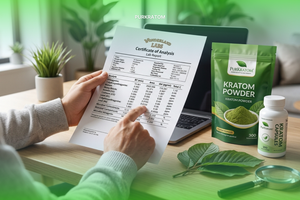
A Certificate of Analysis, or COA, is a laboratory document reporting analytical results for a particular sample. It can provide information about the tested material, but it does not automatically establish that every batch is identical or that the product is risk-free.
4. What should I look for on a kratom COA?
Look for the laboratory identity, report number, sample or product identification, batch or lot information, test date, testing scope, reported results, and units. Most importantly, determine whether the report actually corresponds to the product you are evaluating.
5. Are red, green, and white kratom different species?
No. Red, green, and white are common commercial categories rather than separate kratom species. Color terminology should not be treated as a guarantee of a particular product outcome.
6. Is kratom extract the same as kratom powder?
No. Powder and extract describe different preparations. An extract involves additional processing intended to extract or concentrate certain constituents, which can change the chemical profile of the finished product.
7. Why should buyers pay attention to 7-OH?
7-hydroxymitragynine occurs naturally in trace amounts in kratom, but the FDA has specifically raised concerns about products containing added or enhanced 7-OH. Regulatory developments concerning concentrated 7-OH products have continued, making current verification important.
8. Does higher alkaloid content mean better kratom?
No. A higher measured alkaloid concentration is not automatically a quality ranking. Alkaloid content is one characteristic of a product and should be considered alongside composition, testing, labeling, format, and other documentation.
Finding the “best kratom” is less about choosing the strongest product, the most popular strain name, or the most impressive marketing claim. A more useful approach is to look at what you can actually verify: clear product labeling, identifiable ingredients, accessible laboratory testing, batch or lot information when available, transparent quality practices, and straightforward product documentation. Taking time to compare these details can help you make a more informed purchasing decision based on evidence rather than hype.
If you’re evaluating kratom products, explore PurKratom’s available lab results and product information to review the documentation associated with its products. You can also learn more about kratom formats, quality considerations, and responsible consumer education before making a purchase.
Ready to compare the details for yourself? Visit PurKratom’s lab results and resources and explore the available product collections to make your own informed comparison.
Disclaimer: This content is for educational and informational purposes only and is not intended to provide medical advice, diagnose, treat, cure, or prevent any disease or health condition. Kratom research is still developing, and individual responses may vary. Consult a qualified healthcare professional before using kratom, especially if you take medications, have a medical condition, are pregnant or breastfeeding, or have concerns about potential interactions. Laws and regulations regarding kratom vary by location and may change, so verify current local requirements before purchasing or using kratom.
Based on your interest,
we recommend:
White Maeng Da Kratom Capsules
$26.99
Red Maeng Da Kratom Capsules
$26.99

White Maeng Da Kratom Powder
$31.99
Super Green Maeng Da Kratom Capsules
$26.99

Green Maeng Da Kratom Powder
$31.99